
Alert
(Visible only for enrolled users)
Completing this primer requires dedicated time, undivided attention, and concentrated reading. These modules assume foundational knowledge in the subject area and build on existing clinical understanding. Please ensure you are prepared and review the information below before enrolment
🔍 Quiz Monitoring Enabled:
The quiz is monitored using ProctoPress 🔐 – Exam Proctoring for LMS. Webcam, microphone, and screen activity are recorded during the attempt.
NIMHANS eLearning · Certificate Module · Centre for Addiction Medicine
The Counselling Skills That Actually Close the Gap in Addiction Recovery
Overview of Primer
Overview of Content
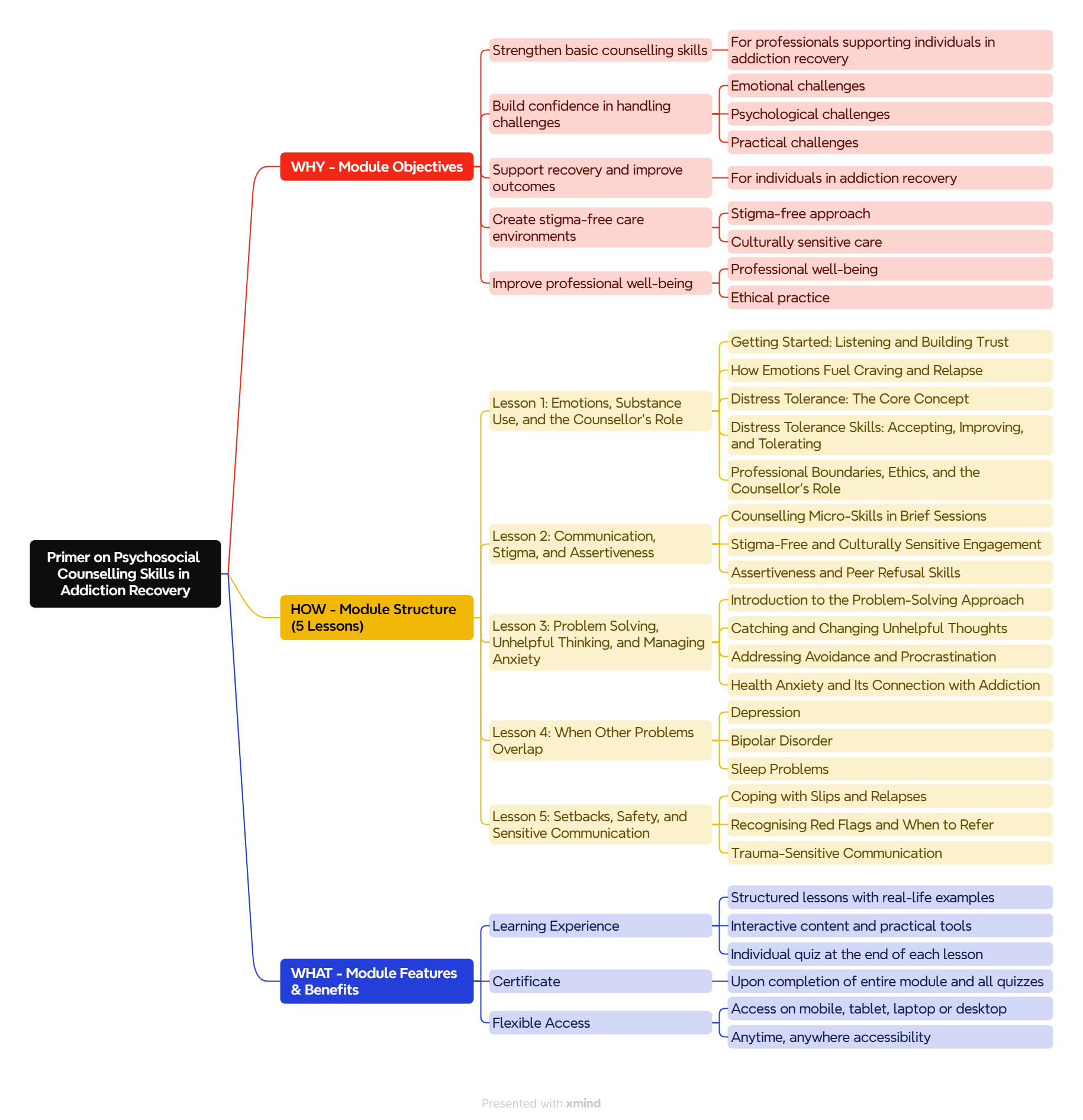
Empower Your Practice: Master Evidence-Based Psychosocial Skills for Addiction Recovery with NIMHANS
This professional development module, developed by the Centre for Addiction Medicine (CAM) and the Virtual Knowledge Network (VKN) at NIMHANS, equips you with practical, easy-to-use psychosocial skills to make a real difference in addiction care, rehab care, and solo-practitioner settings.
This primer introduces key skills to help providers recognise emotional distress, offer brief psychological support, and refer individuals to appropriate care when needed.

Who will get maximum benefit
This primer is designed for counsellors, psychologists, social workers, and lay counsellors who are already working — or are being trained to work — in addiction care settings in India
It may be best suited for the counsellor but can be a learning for any one interested
The primer is particularly relevant for those without formal postgraduate mental health training but with hands-on experience — lay counsellors, community rehabilitation workers, peer support specialists, and social workers who conduct counselling sessions as part of their daily role.
Secondary audience: Masters-level trainees in clinical psychology, psychiatric social work, and psychiatric nursing on field placement at addiction care facilities; programme managers and supervisors overseeing counselling staff in the above settings.
Module Objectives
On completing this primer, you will be able to:
Recognise how emotions, distress, and everyday life stressors connect to craving and relapse, and explain this clearly to clients in plain language
Support clients in building daily routines, managing emotional triggers like anger, shame, and boredom, and using basic distress tolerance strategies without formal therapy
Use basic counselling communication skills — listening, open questions, non-judgmental responses — to build trust with clients from diverse backgrounds in Indian addiction care settings
Recognise when a client needs referral to specialist care, respond to slips without shaming, and protect your own wellbeing as a counsellor working in a demanding setting
Apply simple, structured approaches — including brief problem-solving, managing unhelpful thoughts, and strengthening social support — to common recovery challenges clients face
Sustain & Thrive yourself as a counsellor
Identify early signs of burnout and compassion fatigue in your own practice and apply a self-care framework appropriate for lay counsellors and frontline workers in resource-limited, high-need settings.
Psychosocial counselling Skills v/s Relapse Prevention Primer
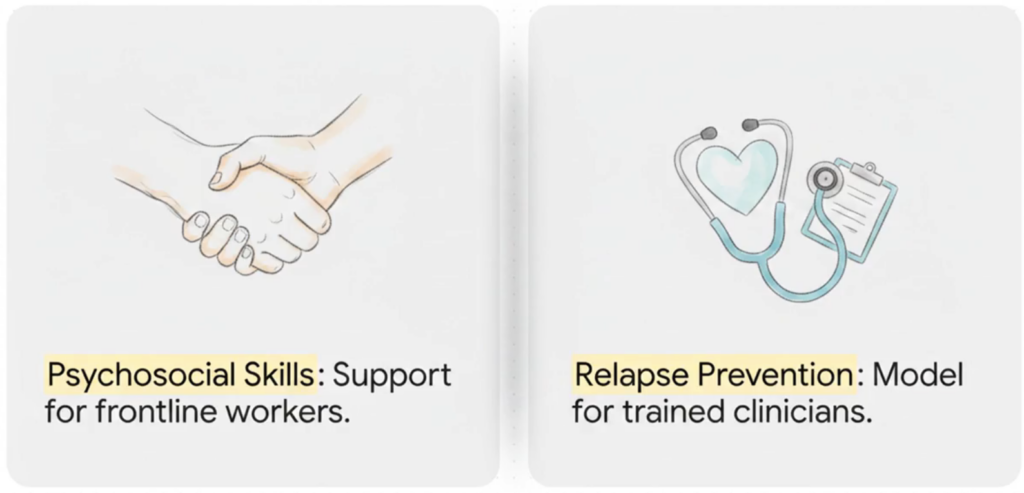
How is this different from the Relapse Prevention Primer?
More on the Relapse Prevention primer
The Relapse Prevention Primer (Intermediate level) teaches the structured Marlatt & Gordon cognitive-behavioural model of RP, designed for trained clinicians. This primer teaches low-intensity support skills for frontline workers — recognising distress, having supportive conversations, and helping clients with everyday recovery challenges. No clinical training needed.
Instructional Design
| Certificate Module | Primer on Psychosocial Counselling Skills in Addiction Recovery. |
| Learning Level | Beginner level. No prior training in counselling or psychology required. Designed for frontline workers who encounter substance use cases in daily practice but have not received formal training in structured therapy |
| Learning Modality | Online, self-paced asynchronous learning via the NIMHANS e-Learning platform. One needs to complete each lesson and topic and successfully pass the quiz (>80%) to go to the next lesson. Estimated engagement: 2–3 hours per lesson, across 5 lessons. |
| Module Structure | 5 Lessons | 18 Topics | 5 Quizzes | 1 Pre-module Survey | 1 Post-module Feedback Lesson 1: Emotions, substance use and Counsellor Role (5 Topics ) Lesson 2: Communication, Stigma and Assertiveness (3 Topics ) Lesson3: Problem Solving and Unhelpful thinking (4 Topics ) Lesson 4 : When other problems overlap(Depression, Bipolar disorder and sleep problems (3 Topics ) Lesson 5: Setbacks, Safety and sensitive communication (3 Topics ) |
| Pedagogical Approach | Evidence and Awareness – Introduces key concepts supported by brief research insights and case examples. Reflection – Encourages self-reflection through short exercises and scenarios to build empathy, reduce stigma, and increase awareness in working with individuals with substance use concerns. Practice – Focuses on simple, practical LIPI skills such as empathetic communication, problem-solving, behavioural activation, and stress-management strategies for use in community and primary-care settings. |
| Design | Developed by the Centre for Addiction Medicine (CAM) and the Virtual Knowledge Network (VKN), NIMHANS, Bengaluru, |
| Duration of Access | 30 days from the date of enrolment. |
| Professional Development Certificate | Upon completion of all lesson quizzes with a score of ≥80%, participants can download an e-Certificate of Achievement displaying their score. Three attempts are allowed for each quiz. Quizzes assess applied understanding through scenario-based and reflective questions, rather than rote recall. |
| Suggested Citation | NIMHANS eLearning, Centre for Addiction Medicine & Virtual Knowledge Network, NIMHANS. Primer on Psychosocial Counselling Skills in Addiction Recovery. Bengaluru, India. Available from: https://nimhanselearning.org/courses/primer-on-psychosocial-counselling-skills-in-addiction-recovery/ |
| Copyright Information | This license requires that reusers give credit to the creator. It allows reusers to copy and distribute the material in any medium or format in unadopted form only, for non-commercial purpose only. https://nimhanselearning.org/courses/primer-on-psychosocial-counselling-skills-in-addiction-recovery/ © 2024 by Virtual Knowledge Network, Centre for Addiction Medicine & NIMHANS Digital Academy is licensed under CC BY-NC-SA 4.0     |
| First Edition | April 2026 |
| Funding and Support | A collaboration between NIMHANS and Mental Health Institute, Odisha Digital Academy for Mental Health, SCB Medical College Cuttack, Dept of Health and Family Welfare, Govt of Odisha, |
| Connect with us | vk*@********ns.in |
| FAQS | 1. Is this an accredited course? This is a professional development certification module from the Centre for Addiction Medicine & NIMHANS Digital Academy and is NOT a formally accredited academic course. 2. How do I get the Certificate of Completion? Complete all lesson quizzes with a score of ≥80%. Three attempts are available for each quiz. Download the e-Certificate of Achievement after successfully completing all requirements. 3. Do I need to complete lessons in order? Yes, you need to complete each topics in lesson and clear its quiz to move on to the next lesson. |
| Team (Content developer, Designer, Faculty, Technical support) | Centre for Addiction Medicine, Virtual Knowledge Network and NIMHANS Digital Academy National Institute of Mental Health and Neurosciences (NIMHANS), Bangalore, India KNOW OUR TEAM |
Generative AI tools were used in the preparation of this content. All materials have been reviewed and validated by subject matter experts before inclusion.
Certificate for Complete Module
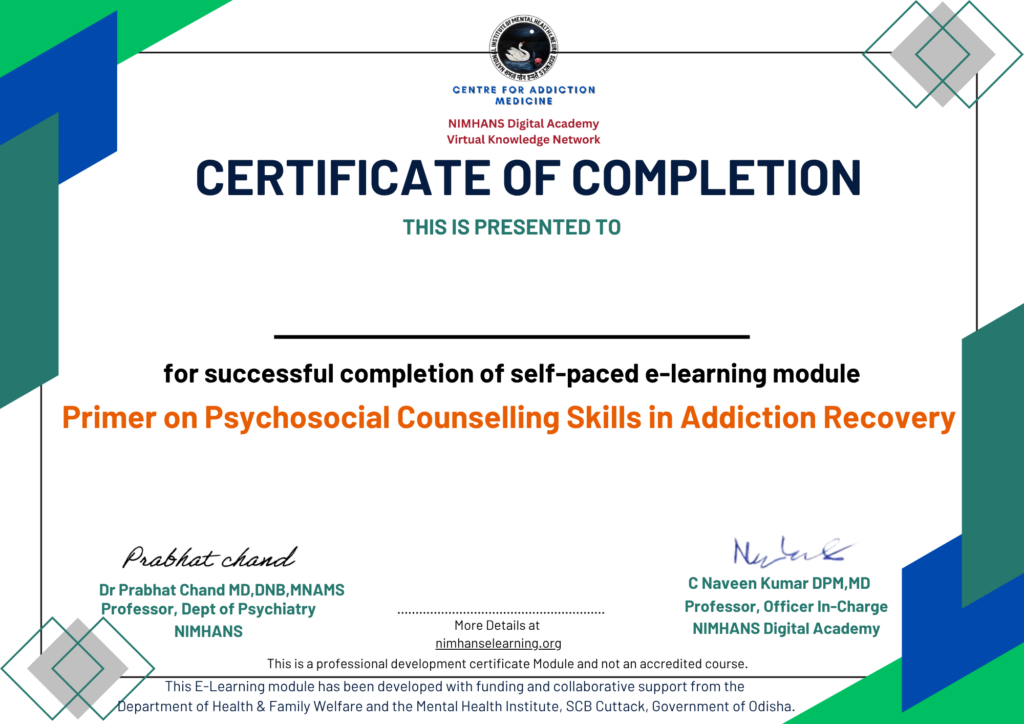
Supported by the Department of Health & Family Welfare and Mental Health Institute SCB Cuttack, Government of Odisha

⭐ There is no registration fee for participants from the Govt. of Odisha. For more details, please contact vk*@********ns.in ⭐
The specific materials are available under each topic.
You must log in and have started this module to submit a review.


It is an extremely well designed course to learn basic counselling and psychosocial interventions for SUD treatment. I enjoyed it throughout. Big shout out for Pravat sir and the whole NIMHANS team