Alert
(Visible only for enrolled users)
Completing this primer requires dedicated time, undivided attention, and concentrated reading. These modules assume foundational knowledge in the subject area and build on existing clinical understanding. Please ensure you are prepared and review the information below before enrolment
🔍 Quiz Monitoring Enabled:
The quiz is monitored using ProctoPress 🔐 – Exam Proctoring for LMS. Webcam, microphone, and screen activity are recorded during the attempt.

Why to build the capacity of Primary health care providers
Primary healthcare settings are the first point of contact for most individuals experiencing mental health concerns. However, many healthcare providers—from medical officers, nurses to community health workers (CHOs)—report insufficient training in identifying and managing MNS disorders. This capacity-building initiative aims to equip all primary care providers with essential competencies to integrate mental health care into routine practice, regardless of their initial professional training background
Primary Healthcare Providers including:
- Community Health Officers (CHOs) at Ayushmann Arogya Mandir
- Staff Nurses and ANMs
- AYUSH practitioners
- Paramedical staff and health workers involved in frontline care
- Medical Officers and Primary Care Doctors working at PHCs, CHCs, and community settings
This module addresses the training gap in MNS disorders, recognizing that many healthcare providers, including medical graduates, may have had limited formal exposure to mental health care during their professional education
While this module was originally developed for CHOs (Community Health Officers) under Ayushman Arogya Mandir AAM’s 12th component (Screening and Basic Management of Mental Health Ailment), the foundational knowledge and skills are equally valuable for health-care providers working in clinical and community settings, who encounter mental health and substance use issues in their practice
Module Objectives
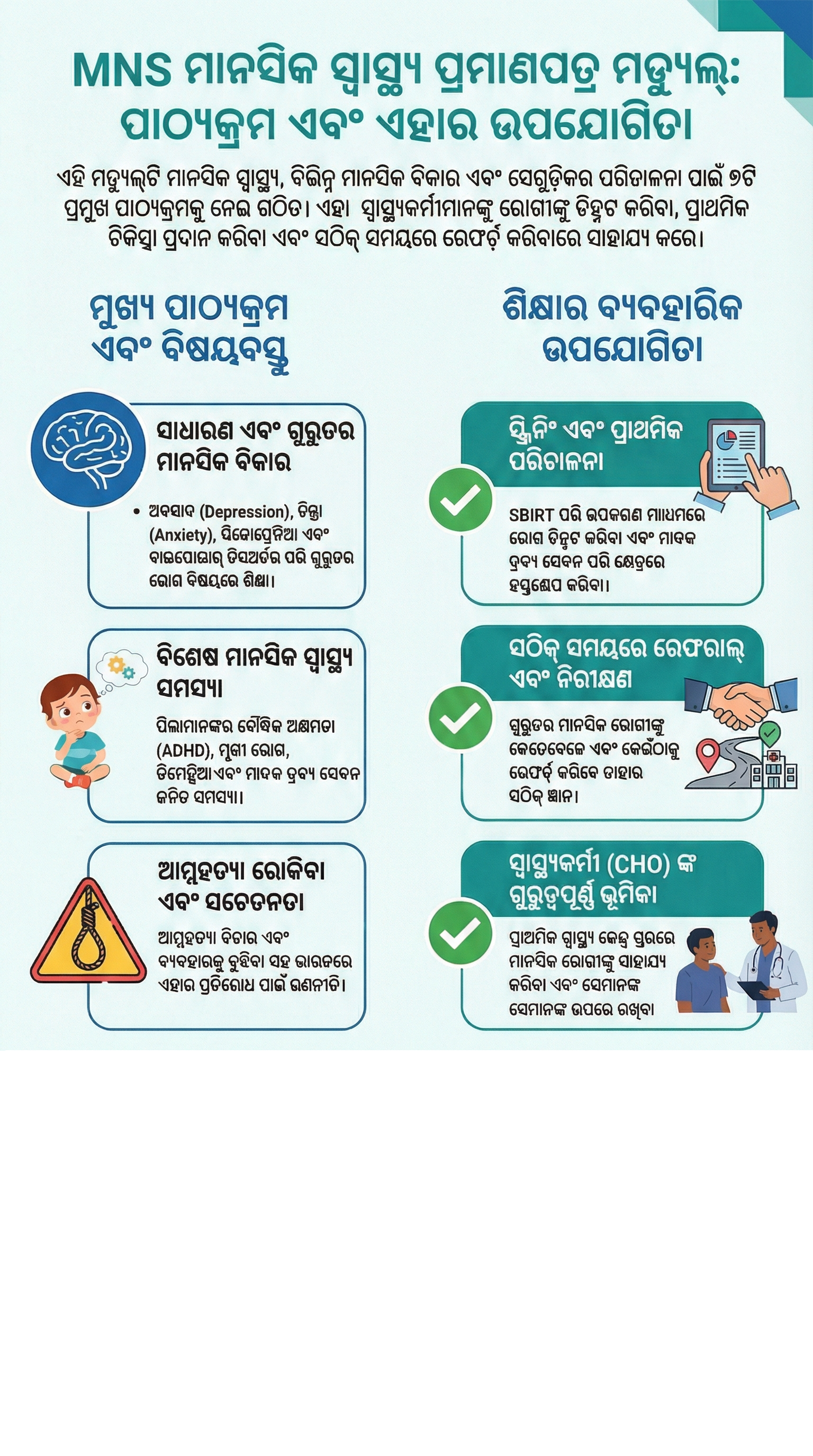
This self-paced module aims to
- Building Foundational Knowledge: Comprehensive understanding on mental wellness promotion, mental illness and substance-related issues common in community health settings.
- Skill Development: Recognizing early signs and symptoms of mental health disorders and substance use problems.
- Providing basic management and psychosocial support.
- Conducting appropriate referrals for specialized care when needed.
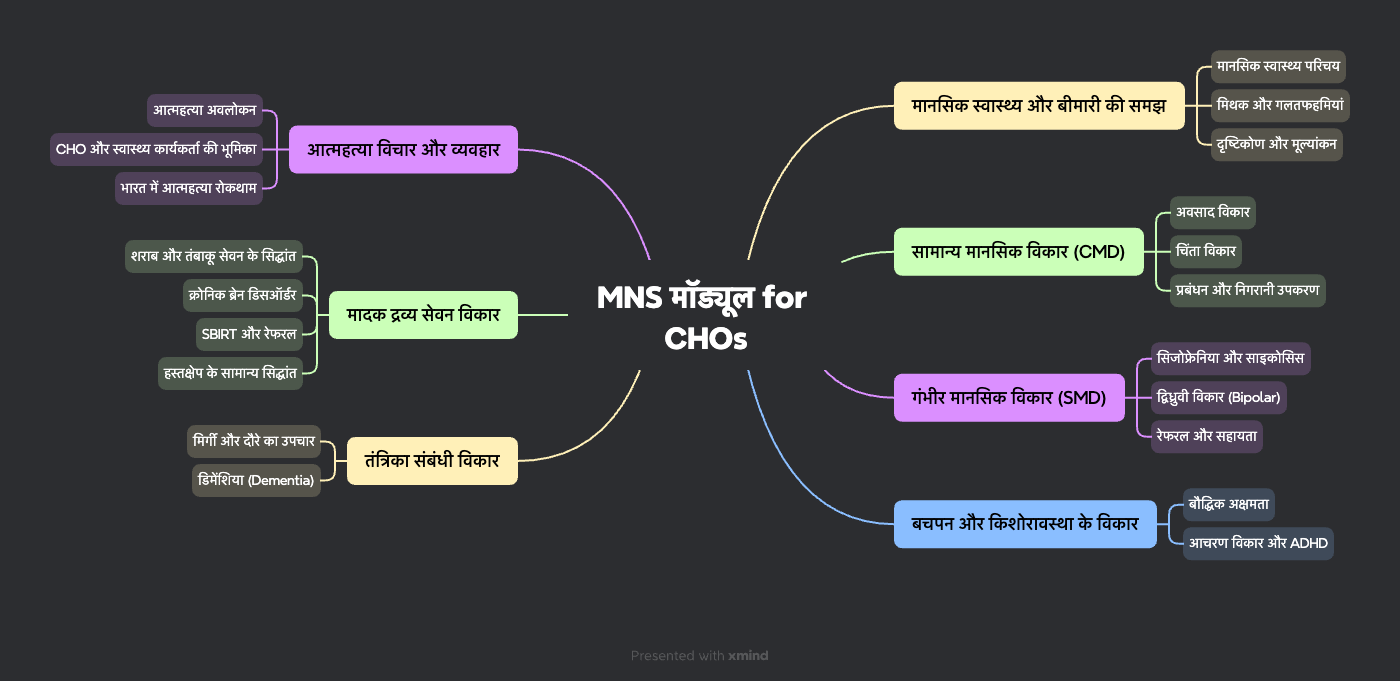
By the end of this module, you as will be able to
- Understand Mental Health Fundamentals:
- Define mental health and explain its importance in overall well-being.
- Identify factors that influence mental health, including protective and risk factors.
- Recognize Common and Severe Mental Disorders:
- Describe symptoms and warning signs of disorders like depression, anxiety, somatization, schizophrenia, and bipolar disorder.
- Manage Mental Health Disorders in Community Settings:
- Provide psychosocial support and counseling using culturally sensitive approaches.
- Identify red flags requiring urgent referral to higher-level healthcare providers.
- Address common Substance Use Disorders:
- Identify common substance use disorders (SUD), including alcohol and tobacco
- Recognize SUD as a chronic brain disorder
- Implement basic counselling strategies like SBRIT and understand referral protocols.
- Outline the criteria for Addiction or dependence and discuss the principles of management
- Reduce Stigma and Promote Mental Health Awareness:
- Challenge common myths and misconceptions about mental health and substance use.
- Advocate for supportive community environments that foster mental well-being.
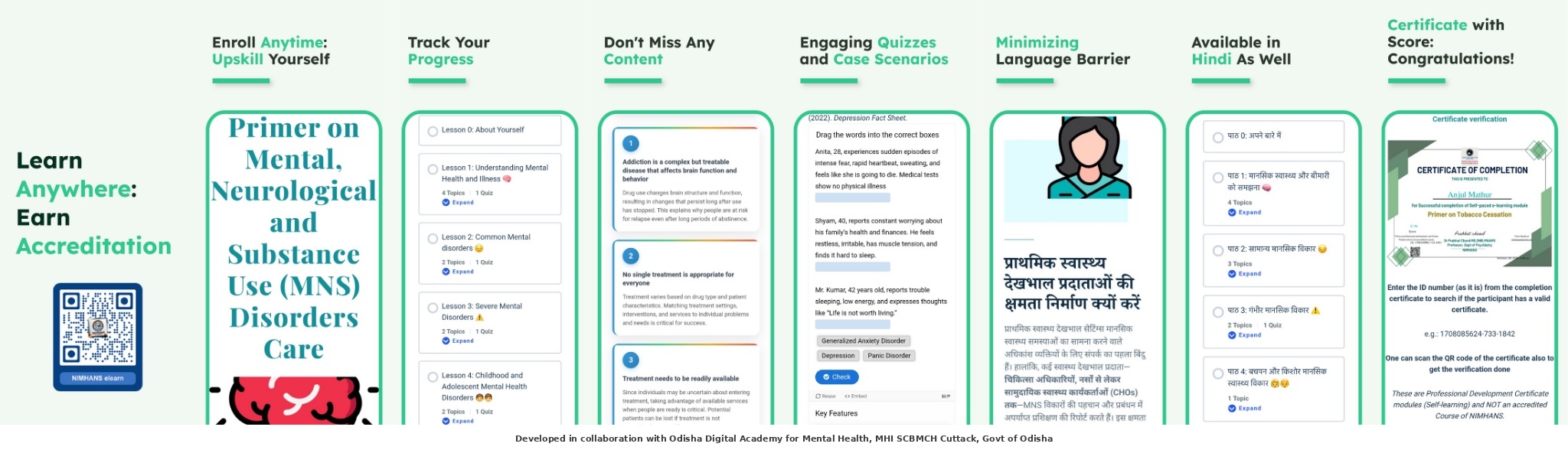
Flexible Learning Path & Certification
⏰ Learn at Your Own Pace
This course is designed for self-paced learning. You can complete lessons in any order based on your learning needs and schedule – there’s no requirement to complete them sequentially.
🏆 Recognition for Your Progress
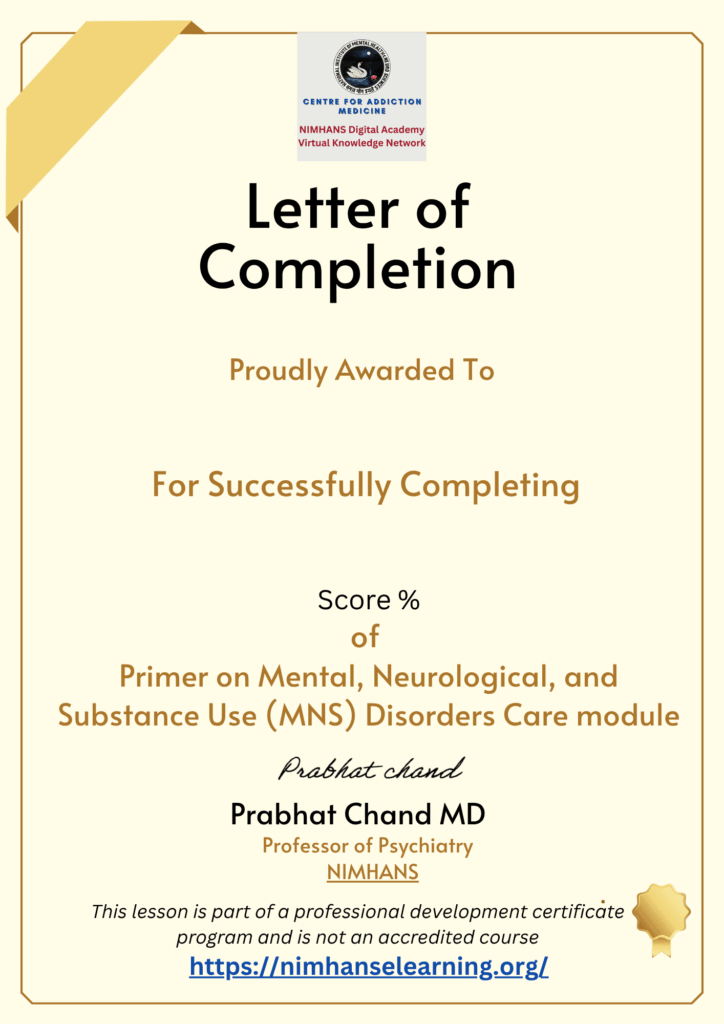
Letter of Completion per Lesson: Complete the quiz for any individual lesson with ≥80% score (3 attempts available) and download your Letter of Completion immediately
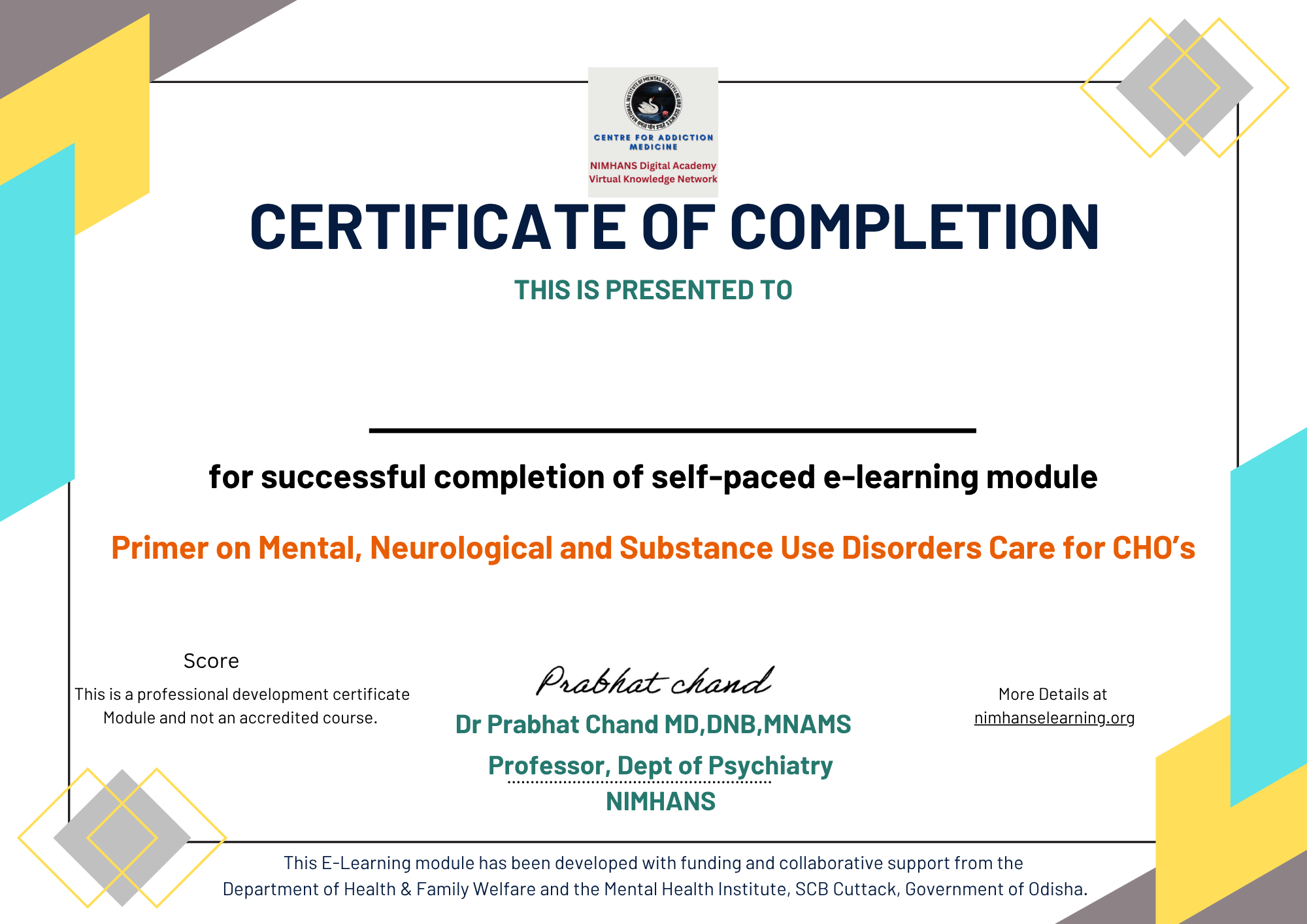
Certificate of Completion for Full Module: Successfully complete quizzes for ALL lessons with ≥80% score in each, and receive your e-Certificate of Completion for the entire MNS Primer module
💡 Why This Matters
With 7 comprehensive lessons covering mental health, neurological disorders, substance use, and suicide prevention, we understand this is substantial learning. Take your time, focus on topics most relevant to your practice first, and build your expertise progressively. Every lesson completed adds to your competence!
📝 Instructional Design 📝
| Certificate Module name | Primer on Mental, Neurological and Substance Use (MNS) Disorders Care |
| Learning Level | Basic or Foundation |
| Target Audience | Non-specialist health workers Primary Healthcare Providers, including: Community Health Officers (CHOs), Medical Officers and Primary Care Physicians working at PHCs, CHCs, and community settings Staff Nurses and ANMs AYUSH practitioners Paramedical staff and health workers involved in frontline care |
| Module Aim | Online, self-paced learning |
| Module objectives | 1. Building Foundational Knowledge: Comprehensive understanding on mental wellness promotion, mental illness and substance-related issues common in community health settings. 2. Skill Development: Recognizing early signs and symptoms of mental health disorders and substance use problems. 3. Providing basic management and psychosocial support. 4. Encouraging positive attitudes and reducing misconceptions about mental health and substance use. 5. Conducting appropriate referrals for specialized care when needed. 6. This self-paced module complements existing medical knowledge and fills critical gaps in MNS disorder training, making it relevant for providers at various levels of prior clinical experience |
| Design | Online, self-paced learning One can take any lesson and comlete |
| Duration of access | Two months |
| Professional Development Certificate | A collaboration between NIMHANS and Mental Health Institute, Odisha Digital Academy for Mental Health, SCB Medical College, Cuttack, Dept of Health and Family Welfare, Govt of Odisha, |
| Suggested Citation | NIMHANS eLearning, Centre for Addiction Medicine, and NIMHANS Digital Academy. Primer on Mental, Neurological and Substance Use (MNS) Disorders Care, Bangalore, India. Available from https://nimhanselearning.org/courses/primer-on-mental-neurological-and-substance-use-mns-disorders-care/ |
| Copyright Information | This license requires that reusers give credit to the creator. It allows reusers to copy and distribute the material in any medium or format in unadapted form only, for non-commercial purpose only. https://nimhanselearning.org/courses/primer-on-mental-neurological-and-substance-use-mns-disorders-care/© 2024 by Virtual Knowledge Network, Centre for Addiction Medicine & NIMHANS Digital Academy is licensed under CC BY-NC-SA 4.0     |
| First Edition Last updated | February 2025 August 2025 |
| Connect us | vk*@********ns.in |
| Funding and Support | A collaboration between NIMHANS and Mental Health Institute, Odisha Digital Academy for Mental Health, SCB Medical College Cuttack, Dept of Health and Family Welfare, Govt of Odisha, |
| FAQs | 1. Recognition status: This is a professional development certification online module from the Centre for Addiction Medicine & NIMHANS Digital Academy and NOT an accredited Course. 2. Certificate of Completion for the Whole MNS module: Complete all quizzes (for all lessons) with a score of ≥80%. Three attempts are available for each quiz. Download the “e-Certificate of Completion” after successfully completing all requirements 3. Letter for Completion of Each Lesson: Complete the respective lesson quiz with a score of ≥80%. Three attempts are available. Download the “Letter of Completion” after successfully passing each quiz. |
| Team (Content developer, Designer, Faculty, Technical support) | Centre for Addiction Medicine and Virtual Knowledge Network and NIMHANS Digital Academy National Institute of Mental Health and Neurosciences (NIMHANS), Bangalore, India Content lead: Dr Prabhat Chand MD, DNB Professor & Head, CAM, NIMHANS |
| Connect us | vk*@********ns.in |
Generative AI tools were used in the preparation of this content. All materials have been reviewed and validated by subject matter experts before inclusion.
Who This Module Is For ✅
Primary Target Learners/Non-specialist Health workers:
Community Health Officers (CHOs) at Ayushman Arogya Mandir Health Centres
Nurses, Counsellors & Health care workers in various programmes (including):National Mental Health Programme (NMHP), National Tuberculosis Elimination Programme (NTEP),Non-Communicable Diseases Programme (NCD), Nasha Mukt Bharat Abhiyaan (NMBA)
Maternal , Child Health and adolescent programme
Staff Nurses and ANMs at primary/Secondary/district healthcare facilities
Primary Care Doctors at PHCs/CHCs
AYUSH Practitioners , Paramedical Staff, NGOS, Policy makers, Researchers
❌ This module may not be Suitable For
Specialized mental health professionals
Psychiatrists and Clinical Psychologists
Those seeking advanced clinical training
Mental health researchers and experts
🎯 Module Scope
This is a PRIMER focusing on foundational knowledge rather than advanced clinical skills. It covers basic recognition, management, and referral of MNS disorders, designed specifically for non-specialized frontline health workers.
Source Materials and References
The content of this module has been developed based on evidence-based guidelines and best practices, with clinical input from experienced mental health clinicians and subject matter experts. The following key resources have been utilized in the development of this comprehensive training module:
Under each topic, you will find additional reading materials in the ‘Materials’ section.
Letter and Certificate
Primary References:
1. Training Manual on Mental, Neurological and Substance Use (MNS) Disorders Care for Community Health Officer
National Health Systems Resource Centre (NHSRC). (2021). Training Manual on Mental, Neurological and Substance Use (MNS) Disorders Care for Community Health Officer at Ayushman Bharat – Health and Wellness Centres.
Ministry of Health & Family Welfare, Government of India.
Available at: https://nhsrcindia.org/sites/default/files/2022-05/MNS%20care%20Training%20manual%20for%20CHO.pdf
2. Oxford Short Textbook of Psychiatry (7th Edition)
Harrison, P., Cowen, P., Burns, T., & Fazel, M. (2017). Shorter Oxford Textbook of Psychiatry (7th ed.). Oxford University Press.
Available at: https://academic.oup.com/book/24682
3. mhGAP Intervention Guide 2.0
World Health Organization. (2016). mhGAP Intervention Guide for mental, neurological and substance use disorders in non-specialized health settings: Mental Health Gap Action Programme (mhGAP) – Version 2.0.
WHO Press, Geneva.
Available at: https://www.who.int/publications/i/item/9789241549790
4. mhGAP Intervention Guide 3.0Mental Health Gap Action Programme (mhGAP) guideline for mental, neurological and substance use disorders. Geneva: World Health Organization; 2023. License: CC BY-NC-SA 3.0 IGO. Available at https://www.who.int/publications/i/item/9789240084278
5. Educational Videos from Prof Suresh Bada Math. May like to subscribe here
Supported by the Department of Health & Family Welfare and Mental Health Institute SCB Cuttack, Government of Odisha

⭐ There is no registration fee for participants from the Govt. of Odisha. For more details, please contact vk*@********ns.in ⭐
📱 Addiction Rx App - Free clinical decision support for addiction care
Download: Addiction Rx App

Very informative content and presentation
You must log in and have started this module to submit a review.


It is a excellent course and the materials are clear cut and well informative.